Let’s Talk about Books, Baby

Warning. Super nerdy post ahead. I have spent the last several days combing the annals of the Internet in the land of Children’s Literature, which has sent me into several rabbit holes of memories the way only books can do. I’ve spared you the walk down memory lane, but I did compile my annual summer reading list of kids books. And I’m totally game to share this list with you.

John and I used to be ridiculously committed to reading to Eliott and  Carter, every single night before bed. When I say “committed” I mean we never didn’t do it. I realize now that the single largest contributing factor to our zeal at the time was the fact that we did not own a TV. But I would also submit that because I was a working mom until Carter was a year old, we also lacked toys and time together. There was just something easy and sweet about snuggling up every night together with some books.

Current Reality

Fast forward a little less than a decade, subtract a salary-paying job, add a couple more kids, school, literacy, actual homework, activities, friends, sports, and the rest of life, and suddenly, the sweetness of book snuggles has been traded for the success of eating dinner together as a family. And by the time dinner is on the table, Netflix is looking a heck of a lot snugglier than a book and my actual eyes and mouth still working after a day spent with kids.

Don’t get me wrong. I’m still a huge reader and my kids are too. All four of them. I’m not lying nor exaggerating when I tell you that several times during an average week my kids are banished to the couch to read books and they actually do it. Even the youngest do it, and they don’t know how to read yet, which makes me think all hope is not lost. I’m mildly ashamed to admit that right now, we don’t read to our kids nearly as often as we could.

Twaddle

The truth is, there is a lot of noise out there when it comes to children’s literature. Like. An inordinate amount of noise. One early educator, Charlotte Mason, labeled such noise “twaddle” and for obvious reasons, I’m letting the word stick. If you are a mom and fancy yourself a reader, you know this. You also know that the TV perpetuates the biggest bulk of the crap out there. And of course that is the first thing my children want to grab when we are at the library. Spiderman easy readers (twaddle), My Little Pony & Barbie (twaddle), and, Disney anything. All of it twaddle.

But this isn’t just true for the little ones and the plethora of picture books out there. This is true for my elementary readers as well. Eliott has read the entire Diary of a Wimpy Kid series at least three times and please don’t get me started on Judy Moody. Just for the record, I do not completely hate these books or others like them. Generally speaking, I’m pretty much game to let my kids read anything that interests them. Of all people I understand the meaning of reading for pleasure.

But this shouldn’t be the only thing my kids are consuming. And–and this is huge–these are not the kind of books I enjoy reading with them. Last summer we were visiting my parents in Tennessee and one of the kids grabbed my mother’s old copy of Winnie the Pooh and asked me to read it. It was fantastic. I mean, fantastic in that juicy way where you just know you are digesting something worth consuming. Even Isaiah, at four years old, giggled through the entire thing. I want more of this in my life, and the lives of my kids.

I daresay, we need more of this in our lives. But where to start?

Books Worth Reading

Next year, three out of our four kids will be attending a Charlotte Mason school. Because of this, I’ve recently reread For the Children’s Sake, a book I first read in a college education class. At its core, the Charlotte Mason approach is a classical education focusing on age-appropriate liberal arts with a heavy emphasis in literature. Among many of her educational theories with which I wholeheartedly agree, a driving principle is that children must read what she calls “living books.” These would be the opposite of twaddle.

I love it. And I’m all in.

So this summer, I’ve done my homework, and we are reading again. Together. As a family. Good books. Worthwhile books. I’ve scoured Goodreads, Barnes and Noble lists, and a plethora of homeschool blogs. I’ve compiled titles I remember, with others that showed up time and again, with others that I know nothing about. I actually started with all the Newbery winners from 2017 down through the dawn of the Newbery award, and I do believe any author on that list can be trusted to be worthwhile.

The Ultimate Summer Reading List for Kids

Essentially, this is a list of books that will pull us out of the cycle of so-so books. These are books every kid should read. Books that I read as a kid and loved. Chapter books and picture books. Classics and modern books.
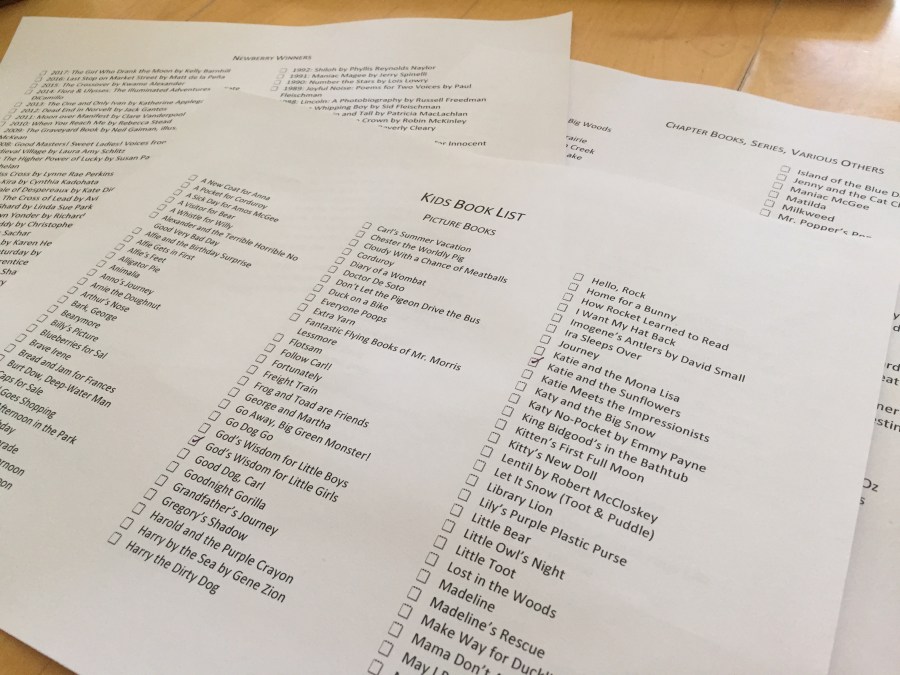
checklist of books to read with your kids

Quick note: the list is extensive and I by no means plan to read every single one of these books aloud to my kids. For me, it is a guide. A goal? Maybe a challenge. But I also want to encourage my big kid readers to tackle many of these on their own.

Note two: many of these titles are the first of a series, others I listed as the common title for the series. I apologize there isn’t a lot of uniformity. I mostly went with what I know. Also, I am positive there are many many many great books that didn’t make the list. It is a work in progress. But I promise you, it is also too much to tackle in one summer.

You know I made a printable list with check boxes. And I’m sharing. No strings attached. As a thank you, I’d sure appreciate a comment below about some of the books you loved as a kid, or love reading now to your kids.

Enjoy!

Picture Books

[su_document url=”https://theundertoad.com/wp-content/uploads/2022/08/7ffdb-kids-book-list.docx”%5D

Newbery Award Winners

[su_document url=”https://theundertoad.com/wp-content/uploads/2022/08/5a126-newbery-winners.docx”%5D

Chapter Books, Series, Various Others

[su_document url=”https://theundertoad.com/wp-content/uploads/2022/08/db68d-chapter-books.docx”%5D


Big Ass Checklist of Books to Read with Your Kids

This post may contain affiliate links. Read my full disclosure here.
 

Summer Reading: Tips for High School Students

You might remember that once upon a time I was a high school English teacher. And a damn good one at that.

I just ran across something I posted to Facebook five years ago (also the final year I was paid to stand in front of a classroom). It was a note to my students of my thoughts on the list their school (not me) sent for summer reading choices.

I got a chuckle out of it today and I think it is worth reposting here. Feel free to pass this nugget along to any high school student you know who still hasn’t thought about that summer reading assignment due August 24th, especially if that assignment came with a list of classics to choose from.

* * * * *

Ok. Enough of you have written looking for my summer reading suggestions – so here are my PERSONAL thoughts. These are by no means endorsed by anyone but me. My final word is read whatever you want, but read the actual book. Don’t just read a Google summary.

I have not read (or even heard of) all the authors on your list, but it should be noted these are not ALL classics (yay) and many of these authors are still alive (hooray). Not that I don’t support the classics (hell-o, I’m an English teacher.) However, I believe classics are best studied in a group, not read independently – as it is difficult to know exactly what is so great about them without the aid of someone smarter than you telling you what to look for. If you wish to tackle the classics, you are awesome but I encourage you to read one with a friend and discuss together. Just don’t get burned-out and cease to love reading because classics are dense and difficult.

Look at me, still using the public library like it’s my job.

Anyway, I’ll do my best to comment on those I know personally, those I recognize, and those which are popular enough that I should probably get to know them.

Three lists:

#1: Probably worth your time:
– Sandra Cisneros (House on Mango Street is pretty good. Short, easy read and good.)
– Toni Morrison (One of Oprah’s heroes, hah – she writes “out of oppression” type stuff, but she’s generally considered good.)
– Alice Walker (The Color Purple is fabulous and also easy to read. Deals with some tough subjects ie: rape and black oppression, but I think I read it in 8th grade so you can handle it. There’s a copy in my old classroom.)
– Willa Cather (I love O Pioneers, if you are into Little House on the Prairie her stuff is is similar.)
– Cormac McCarthy (The Road is currently on my to-read list. We’ll see. His stuff is often made into movies. I think he’s a little dark and somewhat heavy. Probably a good one for guys. But he has several books published that have all been fairly popular – and I figure, if the general public is reading it and liking it, it can’t be too hard to understand. Come on. Not everyone went to private school.)
– Ian McEwan (similar popularity to McCarthy – also lots of books made into movies – though I’ve never read him my sister loved Atonement and she and I might as well be intellectual twins.)
– Jane Austen (She isn’t as obvious as Nicholas Sparks, but her romance is as endearing, if you can get through the Elizabethan Language. You might try her now, and come back to her in college, because you’ll love her more with experience. Trust me.)
– Flannery O’Connor (I loved Moll Flanders the movie. The book is probably good.)

#2: LONG and DIFFICULT (and worth considering in college because) I loved them anyway:
– Dostoevsky (on a HS reading list this is nuts… he’s Russian and the translation of his books makes all the difference in the world on readability, but even then he’s a toughy. Crime and Punishment GOOD; The Brothers Karamazov. GOOD. The Idiot. GOOD. He is fabulous when you are ready to tackle him.)
– Richard Wright (well, Black Boy is easy to read, and good. The rest of his stuff is a little racy and again, probably better in college. I will say this – Native Son involves a man killing a woman and cutting her up and putting her in a furnace and I had to read it for three different college classes, if that entices anyone.)
– Dickens (better studied with others, but again, I love him)
– Melville (Moby Dick is LONG and much of it takes place at sea, which, ulgh… not for me, but I really liked Billy Budd in college.)

#3: Shorter does not necessarily equal better (in short, snoozes) (no pun intended but don’t I rule?):
– Joseph Conrad (Heart of Darkness. Painfully short.)
– Hemingway (he’s a hit or miss with me, and usually a miss – personally. Old Man and the Sea? 100 pages? You might never finish it. No I’m serious. It’s another fishing book. Shoot me.)

Anyway, feel free to let me know what you pick. I’m always interested to hear what you are reading.

LOVE YOU ALL,

Mrs. Wait
//pagead2.googlesyndication.com/pagead/js/adsbygoogle.js

(adsbygoogle = window.adsbygoogle || []).push({});

It’s Raining, It’s Pouring

Books.

I swear. It does not matter when I put a book on hold, nor how many end up in my queue at the public library. Inevitably, they will all arrive in the same week.

I thought about reading Jeffrey Eugenides’ new novel, The Marriage Plot, at the beginning of January. I think my request for one of five books in circulation went in at number sixty-something.

More recently, I added John Irving’s In One Person, and magically was very close to the top of the list. Finally, I had a whim to tackle the entire Chronicles of Narnia this summer, and thought it would be easier to just get the edition that has all seven books bound in one. (They looked so innocent in that cute little paper-back boxed set I got from a book order as a kid. This looks as intimidating as Gone With the Wind. Geesh.)

Continue reading “It’s Raining, It’s Pouring”

Book You Wish You Could Live In

Day 5:

Animal, Vegetable, Miracle by Barbara Kingsolver

I didn’t actually read this book.  It was one of the many audio books I listened to on my half-hour commute to and from work for three years.  I think it would have been a more academic read if I’d actually had the book in hand, because it is a one-year chronicle of Barbara Kingsolver and her family (writer Steven Hopp and two daughters) living as “locavores.”  Though my very infantile gardening habit currently pales in comparison to the things that Kingsolver journalistically records in this book, every once in a while I think I might attempt to expand my garden and have considered purchasing and using this book as a resource.

Essentially, they move to a farm in Virginia, and vow to only eat food that has been grown or raised within fifty miles.  They allow themselves one “luxury item” each (coffee, hot chocolate, dried fruit, and spices) and bring a few things like olive oil and certain grains which are obviously from out-of-town.  In addition to their own vast garden, they raise chickens, shop at local farmer’s markets, and trade with neighbors.  They bake their own bread, clean and eat their own turkeys and roosters, and at one point, Kingsolver begins making her own cheese, which turns into a Friday night homemade pizza tradition.

Essentially, the book reads like a personal journal slash farmer’s almanac slash foodie magazine.  It is organized chronologically and provides tons of information on growing crops, raising animals, and preparing and preserving food.  Kingsolver’s voice is periodically interrupted by short essays from Steven or one of her daughters, which provide recipes along with commentary on controversies like CAFO’s.  I loved it.

It is funny, because my husband grew up on the farm that has been in his family for four generations.  Though his experience was not one of “living off the land” in the extreme way Kingsolver describes, he can remember the rows and rows of canning jars, filled with sweet corn, pears, green beans, and homemade spaghetti sauce.  He’s talked of the dirtiest farm animals in the world (chickens), riding motorcycles at age five, making forts in the rafters of the barn, and Tony the Pony.  But then, every time I mention how fun and healthy it would be to have some land and a huge garden and animals (and eggs!) he reminds me that the life of a farmer is anything but stress-free.

In many ways, this book was like reading a real-life and modern version of Little House on the Prairie.  There is something primitive and instinctual (and probably Biblical) about the desire to grow food.  I would not consider this book a lighthearted or entertaining read, sometimes it was painfully slow.  But it was informative and interesting, and at the time, it helped me escape the condo-life I was living.  I imagined, for a little while, days full of sun and free of social media.

Day 5: Book You Wish You Could Live In

Animal, Vegetable, Miracle by Barbara Kingsolver

I didn’t actually read this book.  It was one of the many audio books I listened to on my half-hour commute to and from work for three years.  I think it would have been a more academic read if I’d actually had the book in hand, because it is a one-year chronicle of Barbara Kingsolver and her family (writer Steven Hopp and two daughters) living as “locavores.”  Though my very infantile gardening habit currently pales in comparison to the things that Kingsolver journalistically records in this book, every once in a while I think I might attempt to expand my garden and have considered purchasing and using this book as a resource.

Essentially, they move to a farm in Virginia, and vow to only eat food that has been grown or raised within fifty miles.  They allow themselves one “luxury item” each (coffee, hot chocolate, dried fruit, and spices) and bring a few things like olive oil and certain grains which are obviously from out-of-town.  In addition to their own vast garden, they raise chickens, shop at local farmer’s markets, and trade with neighbors.  They bake their own bread, clean and eat their own turkeys and roosters, and at one point, Kingsolver begins making her own cheese, which turns into a Friday night homemade pizza tradition.

Essentially, the book reads like a personal journal slash farmer’s almanac slash foodie magazine.  It is organized chronologically and provides tons of information on growing crops, raising animals, and preparing and preserving food.  Kingsolver’s voice is periodically interrupted by short essays from Steven or one of her daughters, which provide recipes along with commentary on controversies like CAFO’s.  I loved it.

It is funny, because my husband grew up on the farm that has been in his family for four generations.  Though his experience was not one of “living off the land” in the extreme way Kingsolver describes, he can remember the rows and rows of canning jars, filled with sweet corn, pears, green beans, and homemade spaghetti sauce.  He’s talked of the dirtiest farm animals in the world (chickens), riding motorcycles at age five, making forts in the rafters of the barn, and Tony the Pony.  But then, every time I mention how fun and healthy it would be to have some land and a huge garden and animals (and eggs!) he reminds me that the life of a farmer is anything but stress-free.

In many ways, this book was like reading a real-life and modern version of Little House on the Prairie.  There is something primitive and instinctual (and probably Biblical) about the desire to grow food.  I would not consider this book a lighthearted or entertaining read, sometimes it was painfully slow.  But it was informative and interesting, and at the time, it helped me escape the condo-life I was living.  I imagined, for a little while, days full of sun and free of social media.

Book that Makes You Cry

Day 4:

The Tale of Three Trees

I cannot remember the last time I watched a movie that didn’t make me cry.  It is a weakness I’ve always had.  But ever since giving birth to my first child (exactly five years ago today), the water works button on the back of my eyeballs has become overly sensitive.  I find myself getting teared up at non-Hallmark commercials and shows like The Biggest Loser or more recently, The Voice.

So of course my new-found trigger-happy emotional gun does not exclude things like books.  Weirdly, I can remember the first book that made me cry.  It was Les Miserables by Victor Hugo, in 7th grade.  (This makes two mentions of my 7th grade English teacher’s influence on my reading addiction.)  I only recently admitted that I had a real problem though, when I found myself finishing Unbroken by Laura Hillenbrand and crying on a stationary bike in the middle of the fitness room at a very crowded YMCA.

Pathetic.

This story, The Tale of Three Trees, is my favorite Christmas story.  I’m sure I heard it as a child in Sunday school or perhaps at summer camp, but ran across a paperback version at the Scholastic Book Fair one year in college, and started reading it every Christmas season to whoever would listen.

No matter how many times I’ve read this book (nor to whom) I always get choked up at the very same line…And suddenly the first tree knew he was holding the greatest treasure in the world…  (No lie, tears in my eyes right now even as I type it.)  Even knowing the line is coming up isn’t enough to emotionally prepare myself to hold it together.  Two years ago I read the story in both Christmas Eve services at church and cried both times.  (To my credit, the entire congregation cried too, and it was nothing short of magical.)

If you have children and you do not own this book, drop everything immediately and purchase it.

Day 4: Book that Makes You Cry

I cannot remember the last time I watched a movie that didn’t make me cry.  It is a weakness I’ve always had.  But ever since giving birth to my first child (exactly five years ago today), the water works button on the back of my eyeballs has become overly sensitive.  I find myself getting teared up at non-Hallmark commercials and shows like The Biggest Loser or more recently, The Voice.

So of course my new-found trigger-happy emotional gun does not exclude things like books.  Weirdly, I can remember the first book that made me cry.  It was Les Miserables by Victor Hugo, in 7th grade.  (This makes two mentions of my 7th grade English teacher’s influence on my reading addiction.)  I only recently admitted that I had a real problem though, when I found myself finishing Unbroken by Laura Hillenbrand and crying on a stationary bike in the middle of the fitness room at a very crowded YMCA.

Pathetic.

This story, The Tale of Three Trees, is my favorite Christmas story.  I’m sure I heard it as a child in Sunday school or perhaps at summer camp, but ran across a paperback version at the Scholastic Book Fair one year in college, and started reading it every Christmas season to whoever would listen.

No matter how many times I’ve read this book (nor to whom) I always get choked up at the very same line…And suddenly the first tree knew he was holding the greatest treasure in the world…  (No lie, tears in my eyes right now even as I type it.)  Even knowing the line is coming up isn’t enough to emotionally prepare myself to hold it together.  Two years ago I read the story in both Christmas Eve services at church and cried both times.  (To my credit, the entire congregation cried too, and it was nothing short of magical.)

If you have children and you do not own this book, drop everything immediately and purchase it.